
The Cold Window Guide to Chinese Internet Literature: Introduction
A "13 Ways of Looking at Chinese Internet Literature" Finale

Welcome to a very special edition of the Cold Window Newsletter! This week, I will be releasing the three-part finale to my year-long 13 Ways of Looking at Internet Literature series. This post is an introduction to the finale, which will run through the rest of the week.
Feature: The Cold Window Guide to Chinese Internet Literature
Stumbling into the world of Chinese internet novels a year ago was one of the most surreal experiences I’ve had since I started reading Chinese literature. As someone used to the (relatively) orderly world of traditional print fiction, it gave me a feeling of profound vertigo to realize that there had been this whole ocean of widely read, widely adored, and yet rarely discussed online novels right under my feet all along. The more I’ve read these novels and realized how fast their genres are mutating and multiplying, the more my feeling of vertigo has grown.
I sometimes feel like a mad prophet of doom, ranting and raving about how Western publishers need to start paying serious attention to Chinese internet novels before they miss their chance. But the way things have progressed in the year since I started this series has only made me more convinced: the translated internet novel wave is coming, and in some ways it’s already here.
There’s the popularity of translated danmei novels among European and American high-school and college students, which famously sent Chinese author MXTX 墨香铜臭 to the top of the New York Times bestseller list in 2021. There’s the community of amateur translators on the English web, who have grown so numerous that now nearly every internet novel becomes available in an (unlicensed) English version the instant it becomes popular in China. There’s the fact that Chinese internet novels aimed at male audiences are starting to come out with English print runs, for the first time in publishing history.
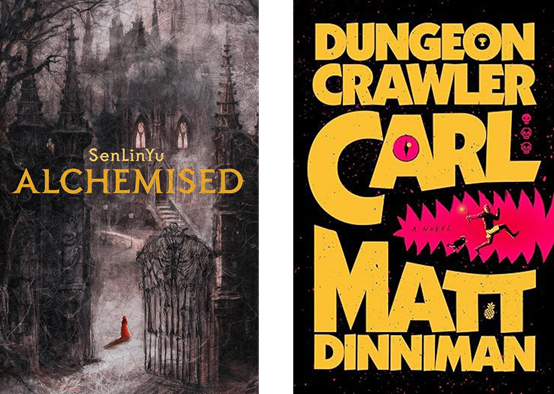
And then there’s the fact that English genre publishing was dominated last year by two distinctly internet novel-flavored pieces of American fiction: Alchemised by SenLinYu, a phone-book-sized revision of a Harry Potter fanfiction, and Dungeon Crawler Carl by Matt Dinniman, an eight-volume LitRPG fantasy series originally serialized on the website Royal Road. LitRPG, long a staple of Chinese web publishing, may not be a staple genre in the West quite yet, but agents and streaming services alike are betting on it — they’re snapping up whatever LitRPG properties they can get their hands on.1 The realization that Chinese webnovels hold a decade’s worth of LitRPG stories with a built-in fanbase will not be far behind.
That’s why I think it’s so important that, if you have any interest at all in Chinese literature (or genre literature, or world literature, or literary translation), you have to be paying attention to internet novels. I’ve been using this blog to provide readers who are new to the scene with on-ramps into this vast and frankly bewildering publishing paradigm. Here are the ways of looking at Chinese internet literature that I’ve written about so far:
Way #1: As an international publishing phenomenon
Way #2: As an object of Western scrutiny

Way #3: As a new way to talk about literary pleasure
Way #4: As a constant cycle of satisfaction and expectation

Way #5: As a taxonomy of story forms
Way #6: As a constantly evolving genre history

Way #7: As a bustling translation ecosystem
Way #8: As an impossible translation conundrum

Way #9: As a vehicle for feminist identity formation
Way #10: As a space for queer exploration
Way #11: As an uneasy dance with state power

But the most fundamental way to understand Chinese internet literature is, of course, to read the novels themselves. That’s what this week is about.
Way #12: As a list of books worth reading
For the last three months, I’ve been talking to dozens of internet authors, translators, editors, platform employees, scholars, students, and fans from all over the world about what novels they would recommend to new readers of internet literature. I’ve asked them to pick niche and lesser-known works that encapsulate the full diversity of this literary form. I figured that, if I’m going to put together a reading list, I might as well source it from the people who know this literature best.
For the rest of this week, I’ll be translating and publishing the messages that I received from these experts, along with links to the works of internet fiction that they endorsed. On Tuesday, I’ll publish recommendations from Chinese university students who currently research internet literature, along with those from fan translators who publish unlicensed versions of their favorite novels on the English internet. On Wednesday, I’ll publish recommendations from internet literature scholars and from professionals working in Chinese online publishing. And on Thursday, I’ll publish recommendations from professional translators of Chinese literature, as well as from a handful of Chinese internet novelists themselves. The entire reading list will be uploaded as a single webpage to Paper Republic on Friday.
This has been a massive undertaking, and thanks are in order to the people who made it possible. I received tremendous help and inspiration from Professor Shao Yanjun 邵燕君, one of the world’s earliest and most influential scholars of Chinese internet literature, and Professor Michel Hockx, who helped introduce the discipline to the West more than ten years ago. Thank you also to the authors Yi Bei 伊贝 and 琢明 Zhuo Ming for their insights into this industry, which is so often closed off to outsiders, especially those outside China. Finally, thank you to the translators and friends who helped me build this amazing list of contributors, including Gigi Chang, Regina Kanyu Wang, Nicky Harman, Emily Jones, Mel “etvolare” Lee, and many others.
Way #13: As a community of readers
This last part is an experiment.
I don’t just want to add to all of our to-read lists. I actually want to carve out time to read these things and develop informed opinions on them.
So, after I’ve published the massive recommendation list as described above, I’d like to start a community here on Substack to sample and discuss, at fixed intervals, some of the works on the list. A book club, if you will.
Readings will probably consist of the first fifty chapters or so of the selected novels (depending on the chapter length of each book). I’ll open a (free) subscriber chat for anyone who wants to participate. If you want to be more closely involved in the book club, or if you have suggestions for how you’d like it to operate, send me a message, or email me at coldwindowlit [at] gmail.
I’m excited for this new adventure. Look forward to the first chunk of the internet literature guide tomorrow.2 Thanks, as ever, for your support.
A big thanks to my friend Oscar for pointing me toward some of these dynamics in American publishing. From his position inside the SFF market, he’s been independently noticing many of the same things I’ve been seeing from the international publishing and translation side.
I’m still working on translating the recommendations, so if I fall behind my declared schedule, forgive me. I’ll do my best to stick to it.
losing my mind at this world getting discussed on substack. ngl kinda worried more eyeballs will destroy these communities in the same way its destroyed manga/anime and eng/american fan fic communities :/
Your post reminded me of Goethe’s fascination with Chinese literature in his conversations with Eckermann and his early intuition of “Weltliteratur.”
The difference is fascinating: Goethe encountered China through scarce and heavily mediated translations, whereas today we face an overwhelming abundance of instantly circulating digital narratives. But in both cases there seems to be the same feeling that an entire literary continent lies outside the traditional Western map. Looking forward to the series.